Top Cyber Threats Targeting Indian SMEs in 2025 — And What to Do About Them
By Aditya Kumar— Founder & CEO, CyberSharcx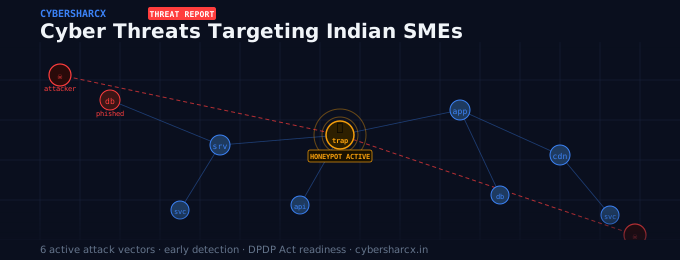
Most small business owners assume cybercriminals go after the big targets — banks, hospitals, government systems. They do not. In 2023, over 43% of cyberattacks globally targeted small and mid-sized businesses. CERT-In logged more than 1.3 million cybersecurity incidents in India that year, and SMEs made up a disproportionate share of victims.
The reason is not sophistication. It is access. Large enterprises have security teams, monitoring infrastructure, and dedicated budgets. Small businesses have a WhatsApp group and a shared Gmail password.
This is a breakdown of the threats actually hitting Indian SMEs right now — and what catching them early looks like before an attack becomes a crisis.
Why Indian SMEs Are a Soft Target
You are not being targeted because you are interesting. You are being targeted because you are accessible.
Most Indian SMEs share a few things that attackers rely on:
- Outdated software and unpatched systems
- No dedicated IT or security personnel
- Heavy use of personal email and WhatsApp for business operations
- Cloud infrastructure set up fast, configured poorly
- Employees with no cybersecurity training
Add India's rapid digital adoption — UPI payments, cloud ERPs, SaaS tools across every sector — and you have millions of small businesses that digitized overnight without building any security layer around that footprint.
The DPDP Act is now pushing SMEs toward compliance, but compliance is not the same as security. A company can check every regulatory box and still get breached on a Tuesday afternoon.
The 6 Biggest Cyber Threats Hitting Indian SMEs Right Now
1. Phishing attacks — still the number one entry point
Phishing is how most attackers get inside a business. An employee gets an email that looks like it is from their bank, a vendor, or their own CEO. They click a link, enter credentials, and within minutes an attacker has a valid login for your internal systems.
In India, phishing campaigns increasingly impersonate government portals — GST, MCA, income tax — along with popular payment apps and large Indian banks. The messages are more convincing than they used to be. Regional language variants, accurate logos, spoofed sender domains.
What makes SMEs especially vulnerable is that there is usually no email security gateway filtering suspicious links, no employee training on red flags, and often no multi-factor authentication protecting the accounts that get compromised.
2. Ransomware — and it is getting cheaper to launch
Ransomware used to require technical skill. Not anymore. Ransomware-as-a-Service platforms now let anyone with a few thousand rupees buy a ready-made attack kit, point it at a target, and wait for the ransom demand to land.
Indian SMEs have been hit hard in manufacturing, logistics, and healthcare — sectors that cannot afford downtime. Attackers know this. They set ransom demands at amounts painful enough to matter but low enough that paying feels like the rational choice.
What most people do not realize is that ransomware does not appear the moment it executes. Attackers typically sit inside a network for days or weeks before deploying. They map systems, disable backups, identify the most critical data. By the time the ransom screen appears, the damage is already done.
3. Credential stuffing and account takeovers
Every few months, a major platform gets breached and millions of username-password combinations leak onto the dark web. Attackers take those credentials and try them automatically against hundreds of other services. This is credential stuffing — and it works because most people reuse passwords.
For Indian SMEs, this shows up as unauthorized access to cloud storage, business email accounts, or SaaS tools like Zoho, QuickBooks, or Tally. The attacker does not make noise. They read emails, steal data, and sometimes use compromised accounts to send fraudulent messages to customers.
4. Supply chain attacks — when your vendor is the weak link
You do not have to be the direct target to get breached. If your business relies on a vendor, software provider, or third-party service with weak security, attackers can reach you through them.
In India, the risk is particularly high for businesses using small local software vendors for ERP, payroll, or billing — vendors who may have never thought seriously about their own security. The breach does not come through your front door. It comes through an integration you trusted.
5. Insider threats — sometimes the problem is internal
Not every threat is external. Insider threats — from disgruntled employees, negligent staff, or malicious insiders — account for a significant share of data breaches that Indian companies never disclose publicly.
A sales employee downloads the entire customer database before resigning. A finance team member accidentally shares a sensitive spreadsheet on a public link. An admin gives someone outside the company access to internal systems. These are not always malicious. Often they are just careless. The outcome is the same either way.
6. Exposed APIs and misconfigured cloud infrastructure
This one is especially relevant for Indian startups and tech-forward SMEs. As businesses move to cloud infrastructure and build or use APIs to connect their tools, misconfigurations become a serious attack surface.
A publicly exposed API endpoint with no authentication. An S3 bucket set to public by accident. A database left with default credentials. These mistakes happen constantly, and attackers use automated scanners that find them within hours of going live. In 2023, multiple Indian fintech and healthtech startups had customer data exposed — not because of sophisticated attacks, but because of misconfigured cloud resources that anyone could access with the right URL.
The Case for Early Detection
Most cybersecurity advice focuses on prevention. Patch this, train for that, enable MFA. All of that is necessary. But prevention alone is not enough.
Attackers will eventually find a way in. The question is how quickly you know about it.
Early detection means catching an intrusion during the reconnaissance phase — when an attacker is probing systems, scanning ports, or trying to understand your network — before they have actually done damage. This is where honeypot-based detection becomes genuinely useful.
A honeypot is a decoy system that mimics real infrastructure but serves no legitimate business purpose. If anything touches it, that interaction is suspicious by definition — no real user or system should be accessing it. Honeypots are particularly effective against automated scanning tools, insider threats mapping internal systems, and early-stage attackers building a picture of your environment before striking.
For SMEs, the practical advantage is a very low false-positive rate. You are not sifting through thousands of alerts trying to find the signal in the noise. You get a notification when something real is probing your environment — which is exactly when you can still stop it.
What You Should Do Right Now
Do not wait for an incident to start taking this seriously.
Enable MFA on everything. Every business account, without exception. This one step removes a large percentage of credential-based attacks from the equation.
Fix your cloud configuration. Audit every S3 bucket, database, and API endpoint for public accessibility. Check that nothing is running on default credentials.
Maintain offline backups. Ransomware only works if you have no alternative to paying. Keep backups that are air-gapped from your main infrastructure and updated at least weekly.
Train your employees. Most phishing attacks succeed because employees do not recognize them. Run a real phishing simulation — not a slide deck — at least once a quarter.
Get visibility into your network. If you have no monitoring, you will not know a breach occurred until it is too late to contain it. Early detection is not a luxury. Under the DPDP Act, knowing about a breach quickly enough to report it is a legal requirement.
Frequently Asked Questions — Cyber Threats for Indian SMEs
What is the most common cyber threat for Indian SMEs? Phishing attacks are the most common entry point. Attackers send deceptive emails impersonating banks, government portals, or vendors to steal employee credentials and gain access to internal systems.
How much does a cyberattack cost an Indian small business? According to IBM's Cost of a Data Breach Report 2023, the average cost of a data breach for organizations with fewer than 500 employees was approximately $3.31 million globally. For Indian SMEs, costs include direct financial losses, regulatory penalties under the DPDP Act, and damage to customer trust.
What is a honeypot in cybersecurity? A honeypot is a decoy system designed to attract and detect unauthorized access. It mimics legitimate infrastructure but serves no real business function. Any interaction with a honeypot is suspicious by definition, making it an effective early-warning tool for detecting attacks before they reach critical systems.
Does the DPDP Act apply to small businesses in India? Yes. The Digital Personal Data Protection Act 2023 applies to any entity that processes personal data of Indian citizens, regardless of company size or revenue. Failing to implement adequate security safeguards — and failing to detect and report breaches promptly — are both violations with significant penalties.
How can a startup with no IT team protect itself? Start with the basics: MFA on all accounts, regular backups, business email with proper domain authentication (SPF, DKIM, DMARC), and employee phishing awareness. For ongoing threat visibility without a dedicated security team, look for platforms built for SMEs that surface early detection signals without requiring expert interpretation.
Is cybersecurity too expensive for small businesses? Less expensive than a breach. A ransomware attack can shut down operations for days. A data leak can cost you customers and trigger DPDP Act penalties. Modern security tools priced for SMEs offer meaningful protection at a fraction of what an incident would cost.
CyberSharcX is an early-warning cyber threat detection platform for Indian startups and SMEs. Honeypot-based detection, behavioral analytics, and automated alerting — built for DPDP Act readiness. Learn more at cybersharcx.in